


Educate Children on Money Through a Mabrey Banker, 'Future Savers' Account

Survey Shows Many Parents Could Use Helping Hand Educating Children about Money

Speak to a Relationship Banker today to set a foundation of financial education

Ensuring children have a positive and healthy relationship with money starts with early basic financial education. Most Americans believe that it is the job of parents to teach their children about money, but often those conversations don’t occur or aren’t as thorough as they need to be. A survey by CNBC + Acorns found that unfortunately more than 30% of parents never speak to their children about their household finances.
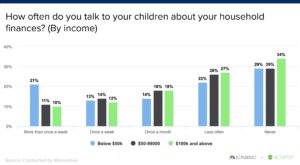
That lack of communication can create a knowledge gap when those children grow to young adults who have started to earn money and might not know the proper way to manage it.

“We see adults and teenagers coming in now, and they don’t even know how to write a check,” said Crystal Jackson, a Relationship Banker at Mabrey Bank’s Bixby Main location. “They can’t fill out a deposit slip. They think if they have a debit card, they can just swipe it whether they have the money or not. It’s so important to teach from a young age that you can’t over-spend the money you have, to learn how to use a check registry and how to use online banking technology.”

That education can start simply, with parents including their children in basic conversations about bills at the dinner table or by letting a child tag along on a trip to the local bank. Debbie Booth, a Relationship Banker at Mabrey’s Haskell branch, sees one father and daughter come in often to tag team deposits.

“He always brings his daughter in to help him prepare his deposits,” said Booth. “She will list the checks, count them up and bring the deposit to us. He started bringing her when she was learning math, and it’s something that has continued between them. Some parents, however, feel their child will listen better if their banker is the one taking the lead on those educational conversations.”

For parents apprehensive on how or where to begin those conversations, coming in to speak to a Relationship Banker at a local Mabrey Bank branch would be a good place to start.

“At Mabrey, we keep it in the family,” said Assistant Branch Manager Jaime Marquez at the South Tulsa location. “Our bankers love working with parents to show their kids how to save money, add money to their accounts, how to use the money you have. I’ve seen multiple generations of families come through the bank where a father will say that his dad helped him open a Mabrey Bank account when he was young, and now he is doing the same for his kids.”

Mabrey Bank also takes an active role itself in getting in front of children and families for early financial education outside the walls of the branches. One example is how Booth and other Mabrey bankers in Haskell make an annual trip to Haskell Elementary to teach children about money. While they keep it simple, its a positive introduction for many young students on the topic of money.

In separate sessions with high school students, Booth and her co-workers go more in depth, explaining the difference between checking and savings accounts, detailed savings books and account registers, even what they needed to open an account. There have also been conversations about how to be responsible with ATM cards and how to prevent overdrafts.

While taking that first step in financial education could be as simple as having a conversation with a banker, parents can increase learning by helping their children younger than 18 open a Mabrey Bank “Future Savers of America” account. It’s an account specifically designed to help teach children about the importance of saving and simple concepts of banking.

“The ‘Future Savers’ account is owned by the child, but it’s controlled by the parent,” said Jackson. “So, the parent is guiding the child, and everything that goes into the account is for the benefit of the child. We have given the child that experience of saving money and then withdrawing it to spend on that special something. It’s the basics of banking, and I think it’s a great starting point.”

From those Future Savers accounts, Mabrey’s bankers have seen children learn to be responsible with money and grow into working adults with established principles and practices.

“A ‘Future Savers’ is their someone’s first concept of a bank account of their own, and we’ve seen several really take ownership of it,” said Booth. “Some teens who have since opened a checking account, with their parent signing the Guarantee and Indemnity agreement, are still faithful to deposit part of their earnings into savings.”

For more information about the “Future Savers” program or other savings accounts, click here or come into any of Mabrey Bank’s 15 locations throughout Oklahoma to learn more about how you can help educate your children about money and basic finances.

 

To benefit students throughout the state, Mabrey Bank will host its second annual School Supply Drive at each of its 15 Oklahoma locations from Monday, July 18 through Friday, July 29. Branches will be uniquely supporting a non-profit education organization or local school district located in its community through the drive.

Customers can easily drop off donations during normal branch hours through a school supply drop box in the lobby at all Mabrey locations. While any and all types of school supplies are appreciated and accepted, Mabrey Bank customers can check in with their local branch to see if any specific supplies are needed, as different schools and communities might have different needs.

See which organization or school that each Mabrey Bank location will be benefitting through this School Supply Drive.

LOCATION – ORGANIZATION

Bixby (Main & North) – Bixby Outreach Center
Glenpool – Glenpool Public Schools
Haskell – Mary White PTA
Morris – Morris Public Schools
Muskogee – Pershing Elementary
Oklahoma City – Positive Tomorrows
Okmulgee (Both Branches) – Okmulgee Public Schools
Tulsa (Broken Arrow, Jenks, Midtown & Yale) – Pencil Box
Weleetka – Weleetka Public Schools
Wetumka – Wetumka Public Schools


TULSA – As Mabrey Bank continues to grow and expand its financial offerings to better serve residents throughout Oklahoma, the bank has hired Brett Myers as Director of Regional and Healthcare Banking. Myers, a local Tulsan and well-known expert in the industry with more than a dozen years of experience, will launch Mabrey’s Healthcare Banking division to provide resources and guidance to all levels of healthcare.

“I’m honored that the Mabrey family has entrusted me to introduce Healthcare Banking as another specialty of our business and to continue to develop our commercial lending regionally,” said Myers. “At Mabrey Bank, we are more than just transaction-focused bankers, we partner with our customers on a personal level. It should be no different in healthcare. I want to work for my clients as a consultant and advisor to grow and sustain all levels of their practice.”

A graduate of both the University of Tulsa and Oklahoma State University, Myers comes to Mabrey after more than 11 years at Arvest Bank where he cultivated valuable relationships with medical professionals across Oklahoma and learned first-hand the unique financial challenges that the healthcare industry faces. Now, Myers will have the opportunity to marry his hands-on approach with Mabrey’s tradition for authentic, personal banking.

Myers and his team will provide a complete line of healthcare banking services, including assisting with the formation of a start-up practice or scaling up multi-site practices. They will offer practices and medical groups guidance with credentialing, billing and collections, electronic health records and practice management software and work with clients to provide additional resources through Mabrey’s banking partners.

With a strong portfolio of regional partners, Myers will also add his commercial lending expertise to Mabrey Bank’s proficient lending team.

Mabrey Bank’s Director of Small Business Lending, Becky Fields, gives back to her community through her work as a member of the Tulsa Rotary Club. Alongside numerous community leaders in Tulsa, Becky has contributed in a variety of roles for the Rotary and recently served as the President for the 2019-20 term.

The Tulsa Rotary addresses challenges in Green Country and around the world through several programs that range from providing clean water to nations in need to supporting education both in Tulsa and abroad. Specifically, Fields is heavily involved in two local programs from the Rotary, Camp Enterprise and Shop with a Cop.

Let her tell you more about how the Tulsa Rotary is impacting their community in a positive way, and how you can get involved to give back alongside Mabrey Bank.

Christmas is just two months away! (Crazy, right?) Follow these 5 Holiday Budget Tips to keep the season merry and bright:

  1. Figure Out How Much You Need to Save!
    Determine your budget for gifts and for special occasions where purchases could include food, drinks, decorations, wardrobe, travel, and any other expenses. Then use this information to come up with your overall savings goal.
  2. Make a Savings Plan!
    Now that you have your savings goal, break it down into bite-sized weekly or monthly goals. This will keep you motivated and on track.
  3. Make a List and Check it Twice!
    Santa can’t be the only one on top of things. Make lists for what you’ll need to purchase and keep an eye out for deals on these items starting now.
  4. Stash Your Cash!
    Once you have your plan, start putting money away ASAP! Some swear by envelopes labeled for different budgets while others like opening multiple savings accounts for special events. Use whichever method will help you keep track and also hold you accountable. #ProSavingsTip: Savings accounts earn interest!
  5. Find Areas to Cut Back!
    This can be the hardest one to follow! Look at your bank statement. If your spending habits don’t leave room for saving, consider cutting back on your weekly Starbucks or monthly entertainment.

Hey Siri! Find a banker near me who will listen to my financial needs…

Let’s talk about how important it is to have a relationship with your banker and banking benefits with a community bank. As a community bank, we must get to know our clients very well to best respond to their wants and needs. The more we know about your business, the better we can provide services and products that work for you. With our bank, you are genuinely valued and not just another account. A deep and genuine relationship is mutually beneficial. It is especially important in times of need.

Our Relationships During COVID-19 

This Covid-19 pandemic had a significant impact on businesses. Our customers relied heavily on Mabrey Bank to process their PPP loan requests. We are proud to say we processed over 930 loans in 2020 through the Paycheck Protection Program. Thanks to the strong relationships that were already in place, we were able to efficiently process these loans. The funds enabled businesses cash to keep people employed.      

If having a meaningful relationship is vital to you, there are several things you should look for when choosing a bank:

  • First, make sure the banker takes time to listen and shows genuine interest in you, your business, and your industry.  
  • Second, research the bank online to learn more about their core values and priorities. Asking others in the community about their experience can be a useful resource as well. 
  • Third, look for a bank that is active in your local community and gives back. Because the Mabrey family and our team members live in the communities where we work, we are deeply committed to giving back to help our communities thrive.

We invest in over 100 nonprofit organizations every year through financial support and the time and talents of our team. Our ties to our clients help mold these relationships to benefit those that need help in our communities. Feel free to check out some of our team members in action in our communities.

If you would like to learn more about the benefits of developing a genuine relationship with a family-owned community bank, give us a call today.   

If your business processes credit cards or debit cards through a website shopping cart, the actual card cannot be swiped or dipped. That type of transaction is referred to as “card not present.” From a security standpoint, this type of transaction contains the most risk for you as a business owner.  So, what can you do to protect your business from fraud? While there is no perfect solution, you can implement some best practices to minimize your risk when processing credit cards and debit cards via a website shopping cart. Here are 10 ways to stay SECURE when accepting credit cards online.

  1. Require full details from cardholder– Make sure your shopping cart requires full name, address, phone number, and email address. If the billing address is different from the shipping address, you should follow up with a phone call. If you cannot reach the customer, or the reason for the different addresses seems odd, you should consider not proceeding with the transaction.
  2. Verify card information– Collect the account number, expiration date, and card security code. Make sure you include the expiration date and the card security code with your transaction authorization. If either doesn’t match or receives a negative response, you should cancel the transaction.
  3. Authorize every transaction– Make sure you receive an approved electronic authorization for every transaction.
  4. Don’t use voice authorizations– If you cannot obtain an electronic authorization, try again later. Avoid using voice authorizations because they can’t be used to help fight a chargeback.
  5. Don’t force authorizations– If your electronic authorization is declined, request an alternative payment method. Do not force the transaction because you won’t be protected in case of a chargeback.
  6. Use Address Verification Service (AVS)– AVS compares the billing address provided by your customer with the billing address on file with the card issuer. If there’s an AVS mismatch, you need to determine if a data entry error caused it. You should cancel the transaction and contact the customer.
  7. Add other fraud detection tools to your shopping cart– Contact your gateway provider about their fraud detection tools. An example would be Velocity Filters that detect when the same card makes multiple purchase attempts within a given timeframe or when there are numerous purchase attempts from the same IP address.
  8. Add a CAPTCHA code to your shopping cart– CAPTCHA codes help verify that the card is entered by a person instead of a robot or a program. http://captcha.net
  9. Settle transactions daily– A daily batch settlement is an easy way to reduce higher transaction fees (after 24 hours your rate goes up!) and reduce disputes from cardholders.
  10. Trust your instinct– A situation that seems too good to be true, or a customer placing a large order under odd circumstances, should raise a red flag and prompt follow-up questions. This is not to say that everything out of the norm is fraudulent. However, being proactive and asking questions when a situation doesn’t make sense can help minimize your risk of fraud or chargeback when processing cards online.

Want to learn more about pro-active ways to help reduce your risk, increase your savings, and grow your business, contact us today. Let’s talk about creating a true business partnership that will help you meet and exceed your goals.

Contact Chris Morgan 918-293-1755

cardprocessing@mabreybank.com

Our children are our future, and it seems like they are always trying to grow up as fast as possible. We all know how important it is to prepare our children for life, and a big part of that is money management. Let’s teach our kiddos to make smart money moves by spending, saving, and sharing. 

It’s Never too Early to Start Teaching Your Child About Money

As soon as your child can count, start teaching them the recognition of coins and bills. You will also want to start explaining how different things have different values. You can do this at the grocery store or toy store. Many younger children are visual learners, so having hands-on experience with money can help them understand it better. 

Understanding the Concept of Needs vs. Wants 

Once your child reaches elementary school, this is an excellent time to discuss needs vs. wants, explain earning money from a job, use allowance or birthday money to spend, save, and donate.  You can use piggy banks, mason jars, or even cupcake wrappers to let them divide their money.  This is also a great time to take them to the bank with you to see the process and even open a savings account.  

Budgeting, Paying bills, and Informational Security

As they get older, you can discuss creating a budget and more in-depth payment options like checks, debit cards, payment apps, online purchases, credit cards, and even fraud.  Reinforce the ‘dangers’ or consequences of some choices, teach them to have a budget, even plan a budget for a mock day. Explain the importance of informational security, aspects like two-factor authentication on accounts, never sharing passwords, and never letting a friend know their pin. 

Money Management for the Teenage Years 

Once they are in high school, you should start discussing loans, their future needs and responsibilities, and how what they do early on will affect their credit and other things like getting a job, buying a house, getting insurance, and so much more. Reinforce the need for them to plan and have a budget for when they are on their own, including everyday needs, emergency savings funds, and future 401k options.  

By having these conversations often, you will build confidence in your kids when it comes to money and teach them skills that will benefit them throughout their entire life. 

Credit scores are an essential part of life. Credit scores help lenders determine how likely you are to repay your debts and help you secure a mortgage when you are ready to buy a house. Your credit score will fluctuate depending on your circumstances, but the good thing about a credit score is that you can always change it. Here are some ways to help you develop a healthy credit score! 

Know Where You Are At

The first way to help you develop a good credit score is by knowing your current credit score. There are tons of free ways to check your credit score, like experian.com or freecreditscore.com. This is a great first step to understanding your credit score and any adjustments you may need to make.

Automate Your Payments 

Another way to help your credit score is by automating all your payments. One way to hurt your credit score is by missing payments or by paying bills late. Many institutions have ways of automating your payments so you can always pay your bills on time. If you bank with us, make sure you have your account set up to make automatic payments! If you don’t know how to set that up, check out our blog on how to get bill pay set up: (link to the blog about paying your bills online.) 

What is Your Debt to Income Ratio?

One way companies determine what to loan you is based on your debt to income ratio. The debt to income ratio is how much money you make annually and how much debt you have. Having a safe and secure debt to income ratio helps companies feel comfortable lending money. Companies generally consider a 30% threshold to be excellent for consumers, meaning no more than 30% of your income goes toward debt obligations.

If you need help identifying ways to help strengthen your credit score, feel free to contact any of our Mabrey Bank employees!

By now, you have most likely heard about digital wallets or have seen merchants have the option to pay with a digital card. You can add these digital tenders to your phone’s digital wallet. Depending on what phone you have, these digital wallets may be called something different.

Types of Digital Wallets:
By Apple: Apple Pay
By Google: Google Pay
By Samsung: Samsung Pay 

Now that you are familiar with some of these digital wallets let’s teach you how to add your Mabrey Bank debit card to your digital wallet. The good news is that this process only takes a few steps! 

For iPhone: 

  1. First, launch the Wallet App. 
  2. Click the plus sign located in the upper right-hand corner of the screen. 
  3. When choosing Card Type, select “Credit or Debit Card” (This should be the first option) 
  4. Add your card by either scanning your card with your phone camera, or you can manually type in your card number. 
  5. Finally, complete the onscreen instructions to complete the process. 
  6. To use Apple Pay, hold your phone near the wireless reader at the register. Then lock your iPhone, use your thumb to double click the home button while the phone remains locked. This will bring up a prompt for you to use your Thumbprint, Face ID, or passcode to confirm your Apple Payment. Once confirmed, this action will send you a digital receipt, and you can be on your way! 

For Android: 

  1. First, Launch the Google Pay App. 
  2. Next, select the “Add a Credit or Debit Card” button at the screen’s bottom. 
  3. Select the “Add a Credit or Debit Card” to bring up the prompt to add your card. 
  4. You can use the camera to scan your credit card or manually enter your credit card number. 
  5. Finally, complete the onscreen instructions to complete the process. 
  6. When you are ready to pay in-store, open your digital wallet app and hold your phone near the wireless reader near the register. Depending on your security settings, you will need to authorize this transaction with Touch ID, Face ID, or a passcode. 


Not only is adding a card to your digital wallet easy, but it is also more secure than traditional payment methods. Sometimes we may be afraid to use technology because it may seem easier to “hack.” However, digital wallets use authentication such as a passcode, face ID, or touch ID to access. Digital wallets also use tokenization, which is the process of turning a meaningful piece of data, such as an account number, into a random string of characters called a token that has no significant value if breached. If a retailer is hacked where you have used your digital card, your card number will not be compromised. Here at Mabrey Bank, we always want to make sure our customers feel safe and that their money is secure. If you have any questions about how to set up your digital wallet, please contact your local bank branch.


Main Office - Bixby Corporate 918.366.4000 Mon-Fri, 9am - 4pm Sat-Sun, Closed